Do Fireworks Increase the Chances of a Lightning Strike?
Fireworks and thunderstorms are a common double-feature during early July in America. Does one lead to the other?

A reader sends in the following question based off of a local Facebook post: can setting off fireworks increase your chances of lightning striking you?
Flashing lights and crashing booms filled the Eastern Nebraska sky on Friday, July 3rd. Americans celebrating the 250th anniversary of the signing of the Declaration of Independence sent millions of dollars’ worth of various powders and chemicals skyward where the blossomed into sensational, colorful displays.
Meanwhile, thunderstorms that formed in the late afternoon, rising high into the warm summer sky, slowly trudged eastward towards a warm, humid air mass.
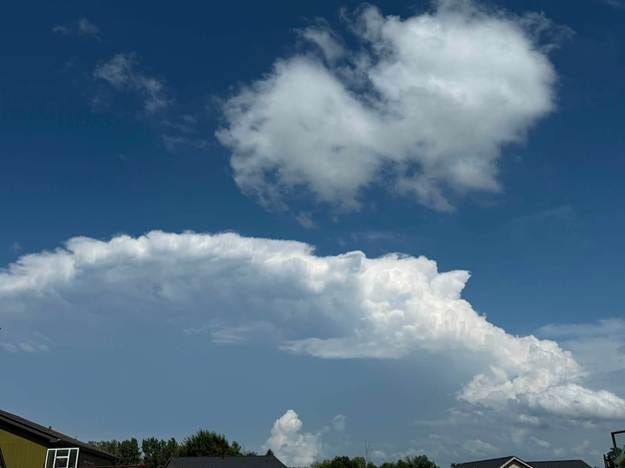
The fireworks mixed with the sky for the second time in four years in Bellevue. A few looks back at 2023:
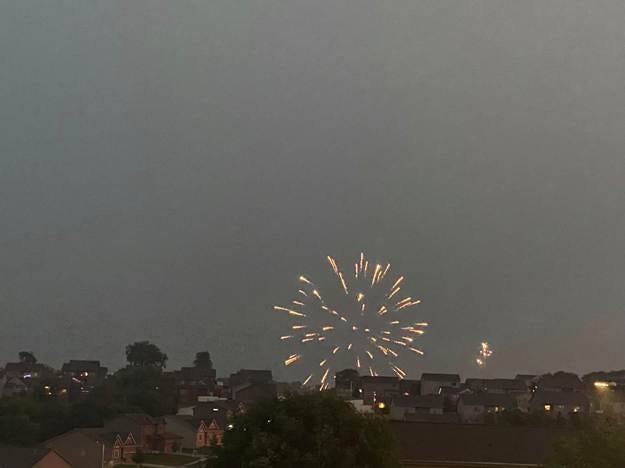
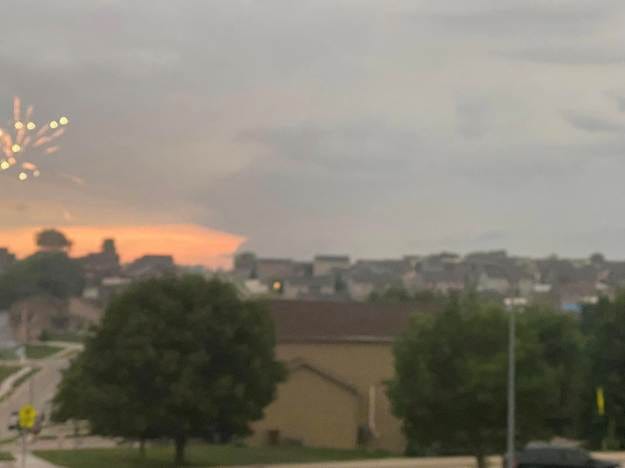
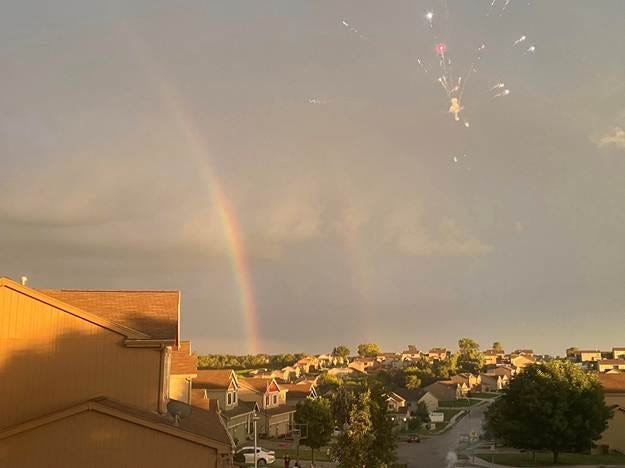
People flock to the outdoors during the summer holidays; more people are outdoors than normal, usually by a significant margin. Many celebrations take place on lakes, where lightning is more favored. Other fireworks displays are common in large, flat, open fields, which make the entertainer the highest point nearby. Some of the equipment in higher-end displays may also be the highest point in the local area, and lightning likes high points. So yes, in general, the risks posed by lightning are higher during the 4th of July weekend because the vulnerability of the population is much higher and nobody wants their holiday and hard-earned day off ruined by a little thunderstorm.
But what about the fireworks themselves? Does anything in the explosive chemistry of these delightful summer displays encourage or discourage lightning from following a particular path?
Yes, in theory, fireworks could help aid a lightning bolt reaching the ground.
Is it likely?
No. In the real world, it is almost completely impossible for lightning to respond to the behavior of a single firework.
Before we get into why it is so unlikely, let us look at how the process would work if it were to happen. What is happening with a firework as it shoots up into the sky?
Typical fireworks contain fuel, a bursting charge, an oxidizer to aid combustion, and salts to provide color for the display. The combustion of the firework creates temperatures of several hundred degrees to thousands of degrees Fahrenheit. Anybody who has been on the wrong end of a firework detonation knows how quickly even a small explosion can cause severe burns.
At these high temperatures, molecules move more quickly, as this blog discussed when talking about the Northern Lights. As molecules move more rapidly, they collide with greater intensity, knocking electrons out of orbit of some of atoms and molecules near the point of the firework explosion. This little piece of air now contains free electrons, who carry a negative charge, and positively charged ions to go along with remaining neutral particles that kept their electrons. These electrons and ions allow electrical current to flow more easily than in normal air. Again, in theory, if a lightning current is near the location of firework detonation, that detonation creates a small, temporary column of air that the lightning bolt finds more attractive.
This process just is not likely in the real atmosphere. Why not?
For starters, the firework only ionizes an exceedingly small piece of air near the surface of the Earth. Even the biggest fireworks detonate only a few hundred feet above the ground; lightning processes often start more than 1-2 miles (5000-10000 feet) in the atmosphere. Think of hiking five miles through thick, unkept forest. If somebody cleans out a few feet of forest at the end of the trail, sure, those last few feet will be easier for you. You will choose that cleaner stretch to end your hike. But you will have to do most of the work yourself to get through the forest, and by the end of the hike, when you get to that easier portion of the trail, you are going to finish the hike anyway. That the trail is cleaner is immaterial to the actual result of you finishing your hike. You are not making a decision to turn around or continue just because a few meters’ of trail is clean or not. If a lightning bolt reaches the ionized path of a firework, something in the area had already attracted the bolt. The lightning bolt is coming to somewhere nearby whether the firework detonates or not.
The firework does not influence what happens in the cloud, thousands of feet above the display, and the bolt begins to form before the firework detonates. The air then quickly recovers, long before something in the cloud above could even theoretically recognize a difference in the air.
Just how small is the firework compared to the lightning? What does a 250-foot-high firework look like compared to a mile-long lightning bolt? The following image approximates what the firework trail, 5% of the length of lightning bolt, looks like stacked up against a sample image of a lightning bolt:
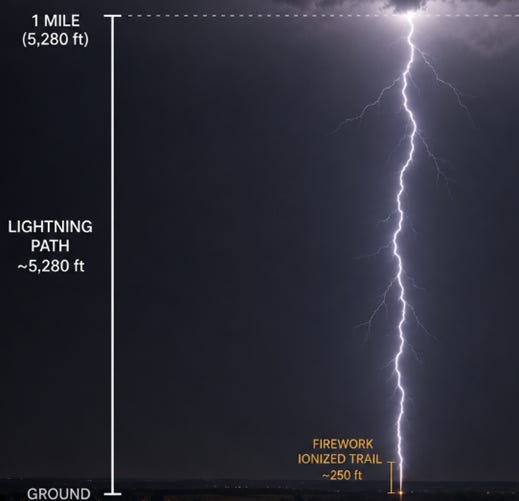
Another prominent reason this combination of events is so unlikely is that fireworks and lightning are both very temporary features. A typical step-latter descension of a lightning bolt takes between 20 and 50 milliseconds, which is indeed fast. However, the ionized trail of the firework lasts for less than 1 millisecond. That event is even faster. We may think that we are saying a lot of lightning or a lot of fireworks on an active night, but in terms of electrical discharge, even the most active nights are mostly empty air. The visuals stick in our brain for seconds and we relive the moments by talking about them. The events themselves, however, are short.
How likely is it that the two events will happen at the same time?
We think that we see a lot of lightning in an active thunderstorm or that we see a lot of fireworks on the 4th. My dog certainly thought there were too many. But what percentage of 3 hours are 50 milliseconds and 1 millisecond, respectively?
In a 3-hour period, 10,800,000 milliseconds pass. That means that one lightning bolt that takes 50 milliseconds, which is a long flash, uses .0000046 of that period. If we have an active storm with 1000 bolts of the same length of time during those three hours, we now see lightning for 50 seconds of the 10,800 seconds, .0046 of that period.
One firework whose ionized path lasts for one millisecond in the atmosphere uses .000000092 of the same three-hour period. If you shoot off 1000 fireworks, you still are only creating an ionized path for 1 second out of 10,800, or about .000092 of that period. We calculate the chance that the .0046 will overlap at any point with the .000092 by multiplying the two values together, giving us a value of .0000004232.
Even if we had all those lightning strikes and fireworks in the same location for the same three hours, we would still only have about a 1 in 2,363,000 chance that the events would overlap at any point. Your odds of flipping a coin “heads” 21 times in a row is about as likely.
Now consider that the lightning bolt can only connect to the firework in the time and area of the firework detonation. We can be generous and say that the lightning bolt, 10-50 times taller than the firework, has 5 milliseconds out of its 50-millisecond life where the bolt may be in the same pocket of air as the firework. Instantly your chances decrease from 1 in 2,363,000 to 1 in 23,630,000. Now you must flip that coin “heads” 25 times in a row, as if 21 were not enough.
Then we consider geography. An extremely active thunderstorm produces 1000 lightning bolts within an area of 20 square miles over our three hours, or approximately 5,180,000 square meters. For lightning to find a firework path, the bolt needs to aim within approximately 25 meters of where the firework was set, giving the lightning bolt a box of 625 square meters. Our stationary thunderstorm now has 8,288 of these boxes in its area. So, we divide our chances further, leaving us with a 1 in roughly 195,845,440,000 chance the right lightning bolt will find the right box at the right time. Your odds of winning the Powerball lottery are about 670 times greater than that, or you would need to flip your coin “heads” 37 straight times in a row.
We know that from time to time, somebody wins Powerball. With about 5 billion tickets sold per year (more when jackpots reach high numbers), 1 in 292,000,000 odds become favorable for *somebody*. If enough fireworks are set off close enough to enough thunderstorms, then yes, eventually, one of the fireworks will find the free electrons and ionized particles, creating a dangerous situation for the attendees. Every rare event will eventually happen if given enough opportunity. Once again, however, if the ionized air influenced the lightning path, then the other targets common to fireworks displays were also influencing that lightning bolt’s path.
Every change to our example scenario to bring more realism to the experiment further demonstrates the rarity of this event. Your thunderstorm will probably not stay in one place for more than one hour. The lightning field is probably much bigger than 20 square miles, and the storm is probably not producing 1000 ground bolts in that time frame. In the real world, the 1 in 195 billion odds we discussed grow even more faint with every caveat we add to the situation.
In short, shooting off the fireworks themselves will not meaningfully increase your risk of lightning striking you. Standing outside for a prolonged period in an active thunderstorm will obviously increase those odds, however, especially on open mountain faces, near tall trees, and on water. The Southeastern United States - Florida in particular - sees a higher concentration of cloud-ground lightning in its thunderstorms.
Nobody wants to give up their holiday, so the best things people can do to stay safe are to:
1) Pay attention to the forecasts on holiday weekends. If it looks like storms are coming for an extended period, try to get your celebrating in on another night. Firework displays do not work if they are moved to the afternoon, obviously. For smaller storms, try to wait them out and let the storm move out of your neighborhood. Your fireworks won’t work in the rain anyway.
2) When storms do move towards your area during a celebration, keep an eye on how much lightning is reaching the ground as the storm gets closer in addition to any warnings for hail, wind, flooding, or tornadoes. Visually, lightning bolts are very impressive, but they are also the best clue we have to the electric nature and potential threats of a storm. Some storms, including one we will talk about on Friday, pose more lightning danger than others, and they usually make their presence known quickly. The best thing to do when out in the open and an electric storm either develops or approaches? Get away from “out in the open.” Find a sturdy building.
Enjoy the holidays! Enjoy the fireworks and the lightning shows!
Just make sure you’re around for the next one.